
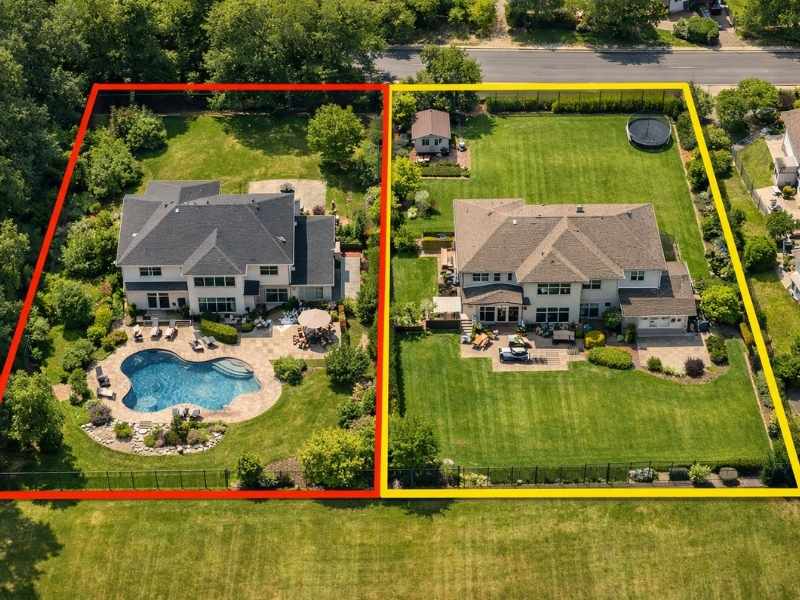
Most homeowners go years without thinking about where their property actually ends. Then something changes. A neighbor starts putting up a fence. A contractor asks for a site plan before pulling a permit. A disagreement comes up over a tree that sits right on the edge of the yard. Suddenly, knowing the exact boundary line feels urgent.
The good news is that there are several ways to get a reasonable picture of where your property lines are. Each method has its strengths, and each has its limits. Knowing the difference helps you avoid making decisions based on information that is not accurate enough to rely on.
Start With Your Deed
Your property deed contains a written legal description of your land’s boundaries. It is the first place to look and the foundation for everything else.
Every property has a deed on file with the local government. That deed describes the boundaries using measurements, directions, and sometimes references to neighboring properties or landmarks. Reading it gives you a starting point even if the language takes some effort to interpret.
Where to find your deed:
- Your county recorder, register of deeds, or clerk of court office
- Your county’s online public records portal
- The title company that handled your home purchase
- Your mortgage closing documents
Older deeds can be especially difficult to read. Some use landmarks that no longer exist or language that requires experience to interpret correctly. Even so, reviewing your deed before taking any other steps is always worth the time.
Check Your County GIS Map
Most counties in the United States maintain a GIS map that shows property boundaries overlaid on aerial imagery. These maps are free, available online, and give you a visual reference for where your lot lines fall in relation to your neighbors.
GIS stands for Geographic Information System. County GIS maps show parcel boundaries, lot dimensions, and sometimes structure footprints. You can usually search by address and zoom in to see your property in detail.
The important thing to understand is that GIS maps are for general reference only. The lines shown on screen can be off by several feet from the actual legal boundary. They are a helpful starting point but not a document you can rely on for construction, fencing, or legal matters.
To find your county’s GIS map, search your county name followed by “GIS parcel map” or “property search” online.
Look for Physical Corner Markers
If your property was surveyed at some point, corner markers were placed at the boundary corners of your lot. These are typically iron rods or pipes driven into the ground, sometimes with a plastic cap stamped with the surveyor’s license number.
Finding these markers gives you a physical reference point for your boundaries. The challenge is that they can be difficult to locate. Soil, grass, and landscaping grow over them. Construction work sometimes disturbs or removes them. In some cases they were never found during a prior transaction and simply went unnoticed.
A basic metal detector can help you locate buried iron pins. Once you find one corner, you have a confirmed starting point. Locating multiple corners gives you a clearer picture of the full boundary.
It is worth knowing that moving or removing a corner marker is a criminal offense in most states. These monuments carry legal significance and are protected under state surveying laws.
Pull the Recorded Plat
If your property is part of a subdivision, a plat was recorded when the subdivision was created. A plat is a drawn map that shows individual lots with their dimensions and boundaries laid out to scale. It is one of the most useful documents for understanding your property lines without hiring anyone.
Recorded plats are public documents. You can find them at your county recorder or register of deeds office, through your county’s online document search portal, or from the title company that handled your closing.
Keep in mind that a plat reflects the boundaries as they were drawn when the subdivision was originally created. It does not account for changes that may have occurred since then, and it is not a substitute for a current survey when precision is required.
Use an Online Property Line Tool
Several websites and mobile apps now display property boundary overlays using publicly available parcel data. These tools pull from the same county GIS databases and show boundary lines on a map you can view from your phone or computer.
They are convenient for a quick visual check. They carry the same limitations as county GIS maps though. The data is not legally precise, it is not always current, and it should not be used for making decisions about construction, fencing, or disputes.
What These Methods Cannot Do
All four approaches above give you useful information. None of them give you a legally certified answer.
County GIS maps, deeds, plats, and online tools help you understand your general boundaries. They are research tools. They are not legal documents that establish where your boundary line officially sits.
Only a licensed land surveyor can establish and certify property lines with legal authority. A surveyor’s findings are documented in a way that holds up in court. A screenshot from a GIS map does not.
If you are planning to build a fence, add a structure, resolve a dispute with a neighbor, or complete a real estate transaction, a licensed surveyor is the only professional whose determination of your property line carries legal weight.